
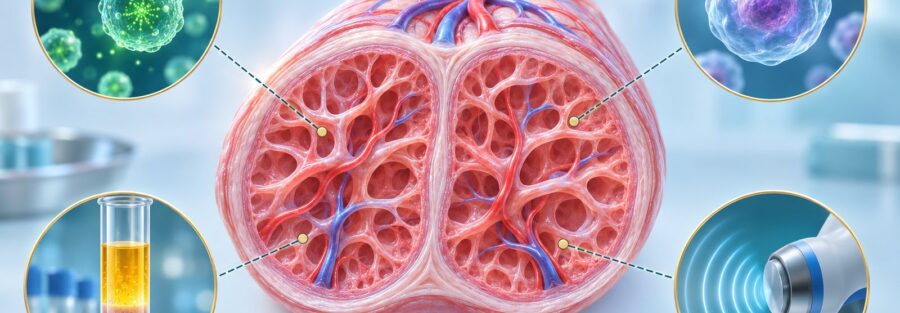
Exosome vs Stem Cell vs PRP vs Shockwave for ED: An Honest Comparison
Medically reviewed
12 min read
Comparing exosome vs stem cell vs PRP vs shockwave for erectile dysfunction (ED), low-intensity shockwave therapy (Li-ESWT) has the strongest evidence and is the only one that European urology guidelines accept for routine use, mainly in mild vasculogenic ED. PRP has a handful of randomised trials with mixed results. Stem cell therapy has early human safety studies with encouraging signals, and exosome therapy is the newest, supported mostly by laboratory and animal research. None of them is a guaranteed cure, all work best in mild to moderate ED, and the right choice depends on what is causing your ED in the first place.
Exosome vs stem cell vs PRP vs shockwave: which regenerative treatment really helps erectile dysfunction? Almost every week a patient arrives with a printout or a screenshot: one clinic offers “exosome rejuvenation,” another “stem cell regeneration,” a third “the P-Shot,” and a fourth “shockwave that cures ED for good.” The question is always the same: which one actually works, and which one is right for me?
I offer regenerative ED treatments in my own practice, so I have every reason to be enthusiastic about them. That is exactly why I think you deserve an honest comparison. This article sets out what each of the four options is, how strong the scientific evidence really is, what results are realistic, and who is, and is not, a good candidate.
Key takeaways
- Shockwave (Li-ESWT): most studied, guideline-supported for mild vasculogenic ED, non-invasive, typically 6–12 sessions.
- PRP: uses your own platelets; some trials show benefit, at least one well-designed trial did not. Considered investigational.
- Stem cells: early clinical studies (including diabetic and post-prostatectomy ED) suggest safety and possible benefit, but large trials are still missing.
- Exosomes: cell-free messengers derived from stem cells; strong laboratory rationale, very limited human data so far.
- None replaces a diagnosis. ED can be an early warning sign of heart disease, diabetes or low testosterone, and these must be checked first.
- Severe ED usually responds poorly to all four; tablets, injections or a penile implant may be more realistic.
Why “regenerative” ED treatment exists
Most erectile dysfunction in men over 40 is vasculogenic: the small arteries and the smooth muscle and lining (endothelium) of the erectile tissue gradually lose their ability to fill and trap blood. Tablets such as sildenafil and tadalafil work well, but they treat the symptom on demand; they do not repair the tissue. If you want to understand the full range of causes first, read why can’t I get hard? 12 medical causes of erectile dysfunction.
Regenerative therapies try to do something different: improve blood flow and tissue health so that natural erections, or the response to tablets, get better. They share one important limitation. They can only work with tissue that is still capable of responding, which is why they perform best in mild to moderate ED and poorly when the erectile tissue is badly scarred.
Shockwave therapy (Li-ESWT)
What it is: low-intensity acoustic waves are applied to the shaft and base of the penis with a handheld device. No needles and no anaesthesia are needed, and each session takes about 15–20 minutes.
How it is thought to work: the mechanical energy creates micro-stress in the tissue, which stimulates growth factors involved in forming new small blood vessels (neovascularisation), improves endothelial function and may recruit the body’s own progenitor cells.
Evidence: this is the most researched of the four, with dozens of randomised, sham-controlled trials and several meta-analyses. Results are not uniform, as devices and protocols vary, but pooled data show a modest, meaningful improvement in erectile function scores, especially in mild vasculogenic ED. The European Association of Urology (EAU) guideline allows Li-ESWT for men with mild vasculogenic ED, or as an alternative for well-informed men who cannot or do not want to take tablets.
Typical course: 6–12 sessions over 3–6 weeks. Effects build up over 1–3 months and, in responders, often last 1–2 years. Side effects are rare and minor.
For a detailed guide, see shockwave therapy for erectile dysfunction.
Platelet-rich plasma (PRP)
What it is: a small amount of your own blood is drawn and spun in a centrifuge to concentrate the platelets. The platelet-rich plasma is then injected into the erectile tissue under local anaesthetic cream. It is sometimes marketed as the “P-Shot.”
How it is thought to work: platelets release growth factors (such as VEGF and PDGF) that may support blood vessel repair, nerve regeneration and tissue healing.
Evidence: mixed. A double-blind, placebo-controlled trial in men with mild to moderate ED reported significantly more men reaching a meaningful improvement with PRP than with placebo at six months. A later randomised, placebo-controlled trial found no significant difference between PRP and placebo. Preparation methods, platelet concentrations and injection schedules differ widely between clinics, which makes results hard to compare. Major urological societies currently regard PRP for ED as investigational.
Typical course: 2–4 injection sessions, a few weeks apart. Because it uses your own blood, allergic reactions are not expected; temporary bruising and soreness are the most common side effects.
Stem cell therapy
What it is: cells capable of supporting tissue repair, most often taken from your own fat (adipose-derived) or bone marrow, are processed and injected into the erectile tissue.
How it is thought to work: rather than turning into new erectile tissue themselves, stem cells appear to act mainly through paracrine signalling: they release growth factors and anti-inflammatory signals that help existing cells, vessels and nerves recover.
Evidence: early-phase human studies, including men with diabetes-related ED and men with ED after radical prostatectomy, have shown the procedure to be feasible and well tolerated, with some men regaining erections firm enough for intercourse. These studies are small and mostly without a placebo group, so the true size of the benefit is not yet known. Guidelines classify stem cell therapy for ED as experimental and recommend it within clinical protocols.
Typical course: usually a single treatment day (harvest, processing and injection), sometimes repeated. It is more involved than PRP and costs more. Read more in stem cell therapy for erectile dysfunction and on our stem cell treatment page.
Not sure which regenerative option fits your type of ED?
Exosomen-Therapie
What it is: exosomes are tiny vesicles released by cells, including stem cells. They carry proteins and genetic messengers (such as microRNAs) from one cell to another. Exosome therapy injects these vesicles, without the cells themselves.
How it is thought to work: because much of the benefit of stem cells seems to come from what they secrete, exosomes are seen as a way to deliver those repair signals in a “cell-free” form that is easier to standardise and store.
Evidence: the laboratory and animal data are genuinely encouraging, with improvements in erectile tissue, nerves and blood vessels in diabetic and nerve-injury models. Human clinical data, however, are still very limited. Product quality also varies widely, and regulators such as the US FDA have warned the public about unapproved stem cell and exosome products. If you consider exosomes, the source, processing and sterility of the product matter as much as the treatment itself.
Typical course: one or more injection sessions under local anaesthetic cream, sometimes combined with shockwave or PRP. More detail is available in exosome therapy for erectile dysfunction and on the exosome treatment page.
Exosome vs stem cell vs PRP vs shockwave: side-by-side comparison
| Shockwave (Li-ESWT) | PRP | Stem cells | Exosomes | |
|---|---|---|---|---|
| Invasiveness | Non-invasive, no needles | Blood draw + injections | Tissue harvest + injections | Injections |
| Strength of evidence | Highest: many RCTs and meta-analyses | Moderate: few RCTs, mixed results | Low–moderate: early-phase human studies | Low: mostly laboratory and animal data |
| Guideline status | Accepted for mild vasculogenic ED (EAU) | Investigational | Experimental | Experimental |
| Typical sessions | 6–12 | 2–4 | Usually 1 | 1–3 |
| Downtime | None | Minimal (1–2 days soreness) | A few days (harvest site) | Minimal |
| When results appear | 1–3 months | 1–3 months | 1–6 months | 1–3 months |
| Best suited for | Mild vasculogenic ED, tablet non-responders with mild disease | Mild–moderate ED, often combined with Li-ESWT | Moderate ED, diabetes, post-prostatectomy (in protocols) | Selected patients in structured protocols |
| Main limitation | Device and protocol quality vary | No standard preparation | Cost, complexity, limited long-term data | Product quality and regulation |
Exosome, stem cell, PRP or shockwave: which is right for you?
The honest answer is: it depends on the cause and the severity of your ED, which is why I never recommend a regenerative treatment before a proper assessment. That assessment usually includes a medical history, the IIEF questionnaire, blood tests (glucose/HbA1c, lipids, testosterone) and, when needed, a penile Doppler ultrasound to measure blood flow.
A practical guide
- Mild vasculogenic ED, wants to avoid daily tablets: shockwave therapy is the logical first step.
- Mild to moderate ED with only partial response to tablets: shockwave, possibly combined with PRP, can be discussed.
- Diabetes-related ED: results are generally weaker; stem cell or exosome approaches may be considered within a structured protocol, alongside good glucose control. See diabetes and erectile dysfunction.
- ED after prostate surgery (nerve injury): stem cells have the most relevant early data; penile rehabilitation should start early.
- Venous leak: regenerative therapy rarely fixes a significant venous leakage; this needs targeted assessment.
- Severe ED, or failure of tablets and injections: regenerative options are unlikely to be enough. A penile prosthesis offers the most reliable result; compare types in inflatable vs malleable penile implant.
- Psychogenic or performance-anxiety ED: regenerative therapy is not the answer; counselling and short-term medication work better.
Can shockwave, PRP, stem cells and exosomes be combined?
Yes, and in practice they often are. The most common combination is shockwave plus PRP, on the reasoning that shockwave stimulates the tissue while PRP supplies growth factors. Combinations of shockwave with stem cells or exosomes are also used. Small studies suggest combinations may give better results than either alone, but the evidence is still early, so a combination should be a reasoned medical choice, not a package upsell. Lifestyle changes remain part of every plan; see natural remedies for erectile dysfunction.
Red flags when choosing a clinic
- A treatment is offered without examination or tests, by phone or message only.
- “Guaranteed” or “permanent” cures are promised.
- The clinic cannot tell you the device (for shockwave) or the source and processing of the product (for PRP, stem cells, exosomes).
- The procedure is performed by someone who is not a urologist or physician.
- You are pushed into a large prepaid package before your cause of ED is known.
- Cardiovascular risk is never mentioned. ED can precede heart disease by several years; see at what age does erectile dysfunction start?
Doctor’s perspective — Op. Dr. Cem İpek
I see regenerative treatment as a way to improve the condition of the erectile tissue, not as a magic reset button. When the patient is chosen well, typically a man with mild to moderate vasculogenic ED, the results can be very satisfying, and some men become less dependent on tablets. When the patient is chosen badly, the same treatment simply wastes his time and money.
When patients ask me to choose between exosome vs stem cell vs PRP vs shockwave, my rule is to start with diagnosis, then use the option with the best evidence for that diagnosis, and only add newer treatments such as stem cells or exosomes when there is a clear reason and the patient understands that the evidence is still developing. If a man has severe ED, I tell him honestly that an implant may serve him better than another round of injections.
Comparing shockwave, PRP, stem cell and exosome therapy?
Get a proper diagnosis, an honest recommendation and a written treatment plan at Androaesthe Istanbul.
Request an international patient consultation → · See erectile dysfunction treatments →
Frequently asked questions
Which is better for ED: exosome, stem cell, PRP or shockwave?
For most men with mild vasculogenic ED, shockwave therapy has the strongest evidence and guideline support. PRP has mixed trial results, while stem cell and exosome therapies are promising but still experimental. The best option depends on the cause and severity of your ED.
Is shockwave therapy for ED proven?
Low-intensity shockwave therapy is the most studied regenerative ED treatment, with many randomised trials and meta-analyses. It is accepted by European urology guidelines for mild vasculogenic ED, although results vary between devices and protocols.
Does PRP (the P-Shot) work for erectile dysfunction?
Some randomised trials show improvement compared with placebo and at least one well-designed trial does not. PRP is safe because it uses your own blood, but it is still considered investigational for ED.
Are stem cell injections for ED safe?
Early human studies using a patient’s own fat or bone marrow cells have shown the procedure to be generally well tolerated. Long-term data are limited, so treatment should be performed by a urologist under a clear medical protocol.
What is the difference between exosome and stem cell therapy?
Stem cell therapy injects living cells. Exosome therapy injects only the tiny vesicles those cells release, which carry repair signals. Exosomes are cell-free, but human evidence for ED is still very limited.
Can regenerative treatments cure ED permanently?
No treatment can guarantee a permanent cure. In men who respond, improvements commonly last one to two years and may need maintenance sessions. The underlying causes, such as diabetes, smoking or vascular disease, also need treating.
Can shockwave and PRP be combined?
Yes. Shockwave plus PRP is the most common combination, and small studies suggest it may work better than either alone. The evidence is still early, so the decision should be based on your diagnosis.
Who should not have regenerative ED treatment?
Men with severe ED, extensive scarring of the erectile tissue, purely psychological ED, untreated serious heart disease, active infection or bleeding disorders are usually not good candidates. A penile implant or other treatments may be more effective.
Do I need tests before choosing a treatment?
Yes. A urologist should assess your history, hormones, blood sugar and cholesterol, and often perform a penile Doppler ultrasound. ED can be an early warning sign of cardiovascular disease.
Op. Dr. Cem İpek, MD
Board-certified urologist and andrologist based in Istanbul, specialising in erectile dysfunction, regenerative andrology including stem cell and exosome protocols, penile prosthesis surgery and Peyronie’s disease. He treats international patients at Androaesthe Istanbul.
- Salonia A et al. European Association of Urology Guidelines on Sexual and Reproductive Health — Erectile Dysfunction. EAU, 2024.
- Burnett AL et al. Erectile Dysfunction: AUA Guideline. J Urol. 2018;200(3):633–641.
- Clavijo RI et al. Effects of low-intensity extracorporeal shockwave therapy on erectile dysfunction: a systematic review and meta-analysis. J Sex Med. 2017;14(1):27–35.
- Poulios E et al. Platelet-rich plasma (PRP) improves erectile function: a double-blind, randomized, placebo-controlled clinical trial. J Sex Med. 2021;18(5):926–935.
- Masterson TA et al. Platelet-rich plasma for the treatment of erectile dysfunction: a prospective, randomized, double-blind, placebo-controlled clinical trial. J Urol. 2023;210(1):154–161.
- Haahr MK et al. Safety and potential effect of a single intracavernous injection of autologous adipose-derived regenerative cells in patients with erectile dysfunction following radical prostatectomy: an open-label phase I clinical trial. EBioMedicine. 2016;5:204–210.
- Bahk JY et al. Treatment of diabetic impotence with umbilical cord blood stem cell intracavernosal transplant: preliminary report of 7 cases. Exp Clin Transplant. 2010;8(2):150–160.
- US Food and Drug Administration. Public safety notification on exosome products. FDA, 2019.
 DE
 EN
 TR