
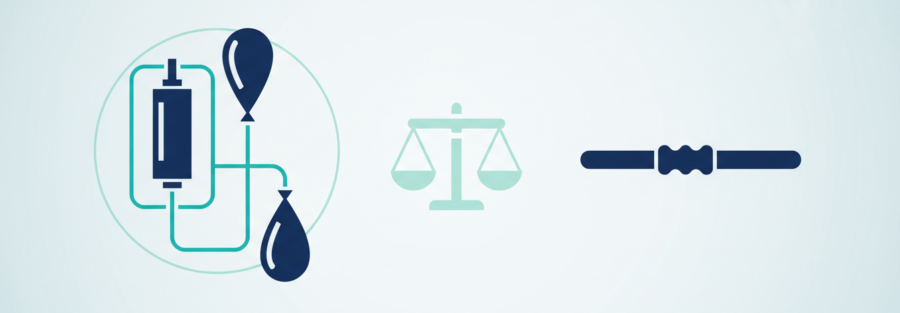
Inflatable vs Malleable Penile Implant: Which Is Right for You?
A three-piece inflatable implant (AMS 700 or Coloplast Titan) gives the most natural feel, best flaccid appearance and highest partner satisfaction, but costs more and requires manual dexterity to operate. A malleable (semi-rigid) implant is simpler, cheaper, more mechanically reliable, and better for men with arthritis, obesity or limited hand function, but the penis stays permanently firm. For most men who can afford it and who can use the pump, the three-piece inflatable is the preferred choice; satisfaction rates for both types exceed 90%.
If you are heading toward penile prosthesis surgery, the second question after “which surgeon?” is “which implant?” There are two main types, and choosing between them is not just a technical decision — it changes how the penis looks day to day, how sex feels, and how the device is used. Marketing brochures rarely give the honest trade-offs.
This guide compares the modern inflatable and malleable penile prostheses on the twelve factors that actually matter to patients: feel, appearance, spontaneity, cost, mechanical reliability, ease of use, surgical recovery, and long-term outcomes. It draws on the AUA and EAU guidelines, published long-term studies, and daily practice with international patients in Istanbul.
Key takeaways
- Three-piece inflatable (AMS 700, Coloplast Titan): most natural feel, best flaccid appearance, highest partner satisfaction, requires manual dexterity to pump, higher cost.
- Malleable / semi-rigid (Genesis, Rigi10): simpler, cheaper, higher mechanical reliability, permanently firm penis, easier for men with hand-function limits.
- Both types have patient satisfaction above 90% in modern series.
- Mechanical reliability at 10 years is above 95% for both, but malleable implants effectively never fail mechanically.
- Choice is driven by hand function, body habitus, discretion needs, cost and partner factors — not by which is “better”.
What are the two types of penile implant?
A penile prosthesis is a medical device implanted inside the corpora cavernosa — the paired erectile chambers of the penis. Two categories dominate modern practice:
Anatomical length or girth is a separate procedure — details on our penis enlargement surgery page.
- Three-piece inflatable prosthesis — two hydraulic cylinders in the penis, a small pump in the scrotum, and a fluid reservoir tucked behind the pubic bone. Pumping the scrotal bulb moves saline from the reservoir into the cylinders, creating an erection on demand. A release valve returns the fluid to the reservoir, and the penis becomes flaccid.
- Malleable (semi-rigid) prosthesis — two flexible silicone rods with a bendable inner core. The penis stays permanently semi-rigid: the user bends it upward for intercourse and downward for daily wear. No fluid, no pump, no reservoir.
A third, older category — the two-piece inflatable (cylinders plus a combined pump/reservoir) — still exists but is rarely used today because it offers few advantages over either extreme.
The three-piece inflatable in detail
The three-piece is the gold standard for erectile dysfunction that has failed conservative treatment. When inflated, it produces a firm, near-natural-looking erection; when deflated, the penis is soft and hangs naturally, which is almost impossible to detect at the gym or in the shower. Modern devices (AMS 700 CX, AMS 700 LGX, Coloplast Titan) have refined pumps, kink-resistant tubing and antibiotic coatings that reduced infection rates from around 5% two decades ago to roughly 1–3% today.
A non-drug option that some men trial first is low-intensity shockwave therapy for ED.
How the patient uses it: The scrotal pump is squeezed 8–15 times to inflate to full rigidity. This takes 30–60 seconds and quickly becomes muscle memory. A discreet release valve or a bend of the cylinders returns it to flaccid.
Key advantages: best-in-class flaccid appearance, most natural erect feel, adjustable rigidity, best partner satisfaction data.
Key trade-offs: higher cost, more moving parts, requires reasonable hand function, small risk of mechanical failure over a decade or two.
The malleable / semi-rigid in detail
The malleable prosthesis has no fluid and no moving parts — just two silicone rods with a shapeable internal core. Once healed, the penis is always the same length and semi-rigid; the man bends it up for sex and down against the thigh the rest of the time.
Regenerative medicine adds a further tier: stem cell therapy for erectile dysfunction.
How the patient uses it: No pump. To have intercourse, the patient simply bends the penis upward. Afterwards, he bends it downward.
Key advantages: mechanically indestructible in practice, simpler surgery, faster recovery, lowest cost, ideal for men with arthritis, spinal cord injury or limited manual dexterity, and for older men who do not want to relearn a new “device”.
Key trade-offs: penis remains firm all the time, which can be noticeable in tight clothing; length is fixed (no expansion); some men find it harder to conceal. It is generally not the first choice for men who value discretion in the changing room or during casual clothing.
Not sure which implant fits your life?
A 30-minute pre-operative consultation covers hand function, body habitus, partner factors and budget — and gives you a personal recommendation.
Side-by-side comparison table (12 factors)
| Factor | Three-piece inflatable | Malleable (semi-rigid) |
|---|---|---|
| Flaccid appearance | Excellent — natural soft penis | Always semi-firm |
| Erect feel | Most natural | Firm but constant |
| Rigidity adjustable | Yes (fully deflated to full rigid) | No (constant) |
| Ease of use | Requires manual pump (8–15 squeezes) | Bend up / bend down |
| Manual dexterity needed | Moderate | Minimal |
| Mechanical reliability at 10 years | > 95% | Effectively 100% |
| Infection rate (modern coated devices) | 1–3% | 1–3% |
| Surgical time | 60–120 minutes | 45–75 minutes |
| Return to sexual activity | ~6 weeks | ~4–6 weeks |
| Cost (Istanbul package) | €7,000–€12,000 | €4,500–€6,500 |
| Discretion in daily life | High | Moderate |
| Best for | Most patients with adequate hand function | Limited dexterity, obesity, budget priority, spinal cord injury |
Feel and appearance
Partner satisfaction studies consistently favour the three-piece inflatable, and this comes down to two anatomical realities. First, when a three-piece is fully deflated, the corpora cavernosa are almost empty of fluid, so the penis feels soft to the partner and hangs naturally. Second, when fully inflated, the girth and rigidity approach a natural erection because the cylinders expand outward, filling the corporal space. A malleable rod is a fixed diameter; it cannot expand.
That said, “most natural” does not mean “identical to a normal erection”. Neither implant restores nocturnal erections, morning erections or spontaneous glans engorgement (the head of the penis is not part of the prosthesis and does not swell as it would naturally). Realistic expectations here are essential.
Spontaneity and discretion
Discretion cuts both ways. The three-piece inflatable is discreet outside the bedroom (flaccid, natural-looking) but less spontaneous during sex — the man has to pump the device before intercourse. The malleable is the reverse: nothing to activate before sex (spontaneous), but the penis is always semi-firm underneath clothing.
The newer, cell-free regenerative sibling of stem cell work is exosome therapy for erectile dysfunction.
For a man who values gym-locker-room privacy or wears tight clothing regularly, this weighs toward the inflatable. For a man whose main concern is straightforward, hassle-free intercourse without pumping, the malleable is often preferred.
Mechanical reliability and revision rates
Both device families are highly reliable. Manufacturer follow-up data reported to the FDA and EMA show mechanical survival above 95% at 10 years and above 80% at 15 years for the modern AMS 700 and Coloplast Titan. Malleable implants, having no hydraulic parts, effectively never fail mechanically — the silicone rods can outlast the patient.
Post-op expectations are in our penile implant recovery timeline.
What that means in practice: a 55-year-old choosing a three-piece has a low but non-zero chance of needing revision surgery in his mid-to-late 60s if he lives long enough. A malleable in the same man is extremely unlikely to fail mechanically. Where inflatables do fail, it is usually a pinhole tubing leak or connector wear — repairable through a single revision that is usually simpler than the original operation.
Surgical complexity and recovery
Both implants are placed through the same penoscrotal or infrapubic incision. The three-piece requires an additional pocket behind the pubic bone for the reservoir; the malleable does not. This adds 15–30 minutes of operating time and marginally increases the technical demands.
Not every man can safely take PDE5 tablets — see Viagra side effects and who should never take it.
Recovery is broadly similar. Most patients spend one night in hospital, take 10–14 days off desk work, and are cleared for sexual activity at 4–6 weeks. Detailed week-by-week recovery is covered in our penile prosthesis surgery page.
Cost differences
The device cost gap explains most of the price difference between the two categories. A three-piece inflatable device costs the hospital roughly €3,500–€5,500 wholesale; a malleable rod set costs €1,000–€2,000. This flows through to the patient. Rough Istanbul package pricing in 2026:
| Device | Category | Istanbul all-inclusive package |
|---|---|---|
| AMS 700 CX (Boston Scientific) | 3-piece inflatable | €8,500–€11,500 |
| AMS 700 LGX (length expansion) | 3-piece inflatable | €9,500–€12,000 |
| Coloplast Titan | 3-piece inflatable | €8,000–€11,000 |
| Rigicon Infla10 | 3-piece inflatable (budget) | €7,000–€9,000 |
| Coloplast Genesis | Malleable | €4,800–€6,500 |
| Rigicon Rigi10 | Malleable (budget) | €4,500–€5,800 |
US and Western European pricing is roughly 2.5–3.5× these figures for the same devices; see our dedicated penile prosthesis surgery page for a full international cost breakdown.
Who is each implant best for?
Better suited to a three-piece inflatable
- Men who value flaccid discretion (gym, tight clothing, communal changing rooms)
- Younger patients (under 65) who want the most natural feel
- Men with intact hand function
- Patients where partner satisfaction is a priority
- Slim to average body habitus (easier to feel the pump)
Better suited to a malleable
- Men with significant arthritis, essential tremor or reduced hand dexterity
- Patients with spinal cord injury who cannot operate a pump
- Severe obesity where the scrotal pump is hard to reach
- Older patients (75+) who want the simplest possible device
- Men prioritising the lowest cost
- Complex revision cases where the corporal space is heavily fibrotic
Match your case to the right implant.
If a diagnosis is missing, start with the 12 medical causes of erectile dysfunction.
Send your medical history for a personalised device recommendation and Istanbul package quote.
Brand overview: AMS 700, Coloplast Titan, Genesis, Rigicon
Boston Scientific AMS 700 CX / LGX
The AMS 700 is the most-implanted three-piece prosthesis worldwide. The CX version expands in girth; the LGX version expands in both length and girth. Both have InhibiZone antibiotic surface coating (rifampin + minocycline). Excellent long-term data.
To gauge baseline risk, see the age-by-age ED prevalence chart.
Coloplast Titan (with Titan Touch pump)
Coloplast’s Titan uses a Bioflex cylinder material with higher tensile strength and a hydrophilic coating that binds antibiotics soaked in at the time of surgery. The Titan Touch pump is easier to operate for some patients.
Coloplast Genesis (malleable)
The Genesis is Coloplast’s malleable rod, with a hydrophilic antibiotic-binding surface, in multiple diameters and lengths.
Rigicon Infla10 and Rigi10
Rigicon is a newer manufacturer that produces both a three-piece inflatable (Infla10) and a malleable (Rigi10) at lower price points than Boston Scientific or Coloplast. Short- to medium-term outcome data are promising; long-term (10-year+) reliability data are still accumulating.
Doctor’s perspective — Op. Dr. Cem İpek
In my Istanbul practice, roughly 80% of international patients choose a three-piece inflatable and about 20% choose a malleable. The malleable share climbs with age: for men over 75 or with significant hand-function limits, the malleable is usually the right recommendation, and the surgery is faster and the recovery smoother.
The most common mistake I see is patients choosing a device based only on price. A three-piece inflatable at €5,000 does not exist — anyone quoting that is using a non-branded device or a refurbished implant, and the revision surgery will cost you more than a proper implant would have. Choose the device family that fits your body and life; then choose the best brand your budget allows.
For couples, I usually recommend the partner comes to at least one pre-operative consultation. Partner satisfaction is very high with both device types, above 85% in modern data, but expectations and preferences differ. Ten minutes of conversation before surgery prevents ten years of quiet disappointment.
When to consider penile implant surgery
A penile prosthesis (of either type) is the definitive step on the ED treatment ladder. It becomes appropriate when:
- PDE5 inhibitors (sildenafil, tadalafil, vardenafil, avanafil) no longer produce a usable erection at maximum dose
- Intracavernosal injections work but are unacceptable long-term
- The underlying cause is severe organic disease (post-prostatectomy, advanced diabetes, spinal cord injury, severe Peyronie’s with ED)
- Vacuum devices are ineffective or unacceptable
- You want a definitive solution rather than lifelong medication
See our page on erectile dysfunction treatment for the full staircase, and the penile prosthesis surgery page for the procedure details. For a personal recommendation, request an international patient consultation and share your medical history.
Frequently asked questions
Which penile implant lasts longer?
Malleable implants have no moving parts and effectively never fail mechanically. Three-piece inflatables have mechanical reliability above 95% at 10 years and above 80% at 15 years. In practice, a well-placed implant of either type is very unlikely to need revision within the first decade.
What is the most popular penile implant?
The Boston Scientific AMS 700 (CX or LGX) is the most-implanted three-piece prosthesis worldwide, followed by the Coloplast Titan. Among malleable implants, the Coloplast Genesis and Rigicon Rigi10 are the most commonly used in international urology practice.
Can a penile implant be removed or changed?
Yes. Both device types can be surgically removed and, if desired, replaced with a different implant. Revision surgery is more complex than the original because scar tissue forms in the corpora cavernosa, and outcomes are somewhat less predictable, but experienced surgeons routinely perform revisions with high success.
Does a penile implant feel natural to the partner?
Partner satisfaction studies exceed 85% for both device types. A three-piece inflatable is typically judged more natural because it becomes soft between intercourse and firm on demand. A malleable feels firm at all times, which some partners find distinctive but not necessarily unpleasant. The glans (head of the penis) is not part of any implant and does not swell.
Can I use a penile implant if I have poor hand function?
A three-piece inflatable requires the ability to squeeze the scrotal pump 8–15 times to inflate. Men with significant arthritis, essential tremor, previous stroke or spinal cord injury may struggle. In these cases a malleable prosthesis is usually the better choice because it needs no pumping — the penis is simply bent up or down.
Which is better if I am overweight?
Significant obesity can make the scrotal pump difficult to feel and operate, and the extra abdominal wall thickness can complicate reservoir placement for a three-piece. Some experienced surgeons prefer a malleable in these cases; others use a three-piece with a customised approach. This is a personal decision made during the pre-operative consultation.
How much does an inflatable penile implant cost compared to a malleable?
In Istanbul in 2026, a three-piece inflatable all-inclusive package is €7,000–€12,000; a malleable is €4,500–€6,500. In the US the same devices cost roughly US $25,000–$35,000 (inflatable) and US $16,000–$22,000 (malleable). The device wholesale cost accounts for most of the difference.
- American Urological Association (AUA) Guideline: Erectile Dysfunction, 2023 amendments — penile prosthesis section.
- European Association of Urology (EAU) Guidelines on Sexual and Reproductive Health, 2024 edition.
- Wilson SK, Delk JR, Salem EA, Cleves MA. Long-term survival of inflatable penile prostheses: single surgical group experience with 2384 first-time implants. J Sex Med. PMID: 17419812.
- Levine LA, Becher EF, Bella AJ et al. Penile prosthesis surgery: current recommendations from the International Consultation on Sexual Medicine. J Sex Med. PMID: 26944461.
- Bettocchi C, Palumbo F, Spilotros M et al. Patient and partner satisfaction after AMS inflatable penile prosthesis implantation. J Sex Med. PMID: 20141591.
- Kim DS, Yang KM, Chung HJ et al. AMS 700CX/CXM inflatable penile prosthesis has excellent mechanical reliability at long-term follow-up. J Sex Med. PMID: 20807325.



 DE
DE  EN
EN  TR
TR