
Venous Leak Erectile Dysfunction: Symptoms, Diagnosis and Treatment Options
Medically reviewed
11 min read
Venous leak erectile dysfunction (veno-occlusive dysfunction) means the penis can fill with blood but cannot hold it, so erections start but fade quickly or never become fully firm. It is diagnosed with a penile Doppler ultrasound after an erection-inducing injection, and sometimes with cavernosometry. Many men still respond to tablets, injections or a constriction ring. Venous surgery helps only a carefully selected minority, and for severe, treatment-resistant venous leak a penile implant gives the most reliable result.
Venous leak erectile dysfunction is one of the most misunderstood causes of erection problems. A typical patient tells me: “I get an erection, but I can’t keep it.” He has often tried several tablets, read about “venous leak” online and is worried that he needs an operation. Sometimes he does have a venous leak; often the picture is more complicated.
This guide explains what venous leak is, why it happens, how it is properly diagnosed, and which treatments genuinely work, including the honest truth about venous surgery.
Key takeaways
- The problem is storage, not inflow: blood enters the penis but escapes through the veins too early.
- Typical sign: erections begin normally but lose firmness quickly, and tablets help less than expected.
- Diagnosis needs a test: a penile Doppler ultrasound with an injection; symptoms alone are not enough.
- Anxiety can mimic venous leak on the Doppler, so the test must be done and interpreted carefully.
- Treatment is stepwise: tablets, constriction rings, injections, then surgery for selected men.
- Penile implant is the most dependable solution when other options fail.
What is venous leak erectile dysfunction?
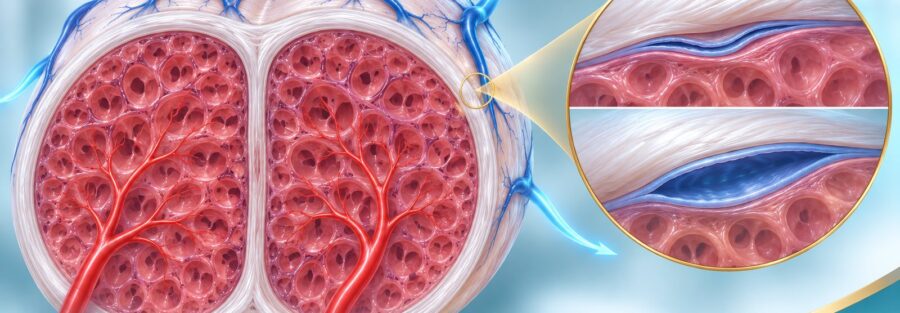
An erection depends on two things happening at once. First, the arteries open and the spongy erectile chambers (corpora cavernosa) fill with blood. Second, as the chambers expand, they press the small veins beneath their tough outer layer (the tunica albuginea) shut, so the blood is trapped. This trapping is called the veno-occlusive mechanism.
In venous leak, also called veno-occlusive dysfunction or corporo-venous occlusive dysfunction, this trapping fails. Blood flows in normally but drains out through the veins too early, so pressure inside the penis never rises enough for a rigid, lasting erection.
It is important to understand that, in most men, the veins themselves are not “broken.” The real problem usually lies in the erectile tissue: its smooth muscle no longer relaxes and expands fully, so it cannot compress the veins. This is why simply tying off veins often fails, as explained below. For a wider overview of all causes, see 12 medical causes of erectile dysfunction.
What causes venous leak?
- Ageing and tissue changes: loss of smooth muscle and increased fibrosis in the erectile tissue, the most common cause.
- Diabetes, high blood pressure, high cholesterol and smoking: these damage the lining and muscle of the erectile tissue. See diabetes and erectile dysfunction.
- Peyronie’s disease: plaques in the tunica albuginea can stop it from compressing the veins. Read more in Peyronie’s disease treatment.
- Trauma: penile fracture or pelvic injury.
- Previous priapism (a prolonged painful erection), which can scar the tissue.
- Pelvic or prostate surgery and radiotherapy.
- Congenital or abnormal veins: rare, usually in young men who have had poor erections since their first sexual experiences.
Symptoms of venous leak
Venous leak has a fairly recognisable pattern, but none of these signs proves it on its own:
- Erections start normally but lose firmness within seconds or minutes.
- Difficulty keeping an erection during penetration or when changing position.
- Erections that are never more than partly firm, even with strong arousal.
- Weaker response to tablets such as sildenafil or tadalafil than expected.
- Fewer or weaker morning erections.
Performance anxiety produces very similar complaints: the erection fades because stress hormones constrict the erectile tissue, not because of a leak. This overlap is the main reason a proper test is essential.
Losing erections quickly despite tablets?
How venous leak is diagnosed
1. History, examination and blood tests
The assessment starts with your history, the IIEF questionnaire, a genital examination and blood tests including glucose (HbA1c), lipids and testosterone. These identify risk factors and other causes.
2. Penile Doppler ultrasound
This is the key test. A small dose of a medicine that produces an erection is injected into the penis, and blood flow is measured with ultrasound over several minutes. Doctors look at two main values:
- Peak systolic velocity (PSV): shows whether the arteries bring in enough blood. A low value points to arterial disease.
- End-diastolic velocity (EDV): shows whether blood keeps flowing out at the peak of the erection. A persistently high value (commonly above about 5 cm/s) with good arterial inflow suggests venous leak.
Anxiety in the clinic can block the injection’s effect and create a false picture of venous leak. A careful examiner gives a repeat dose or additional stimulation when the response is incomplete, before drawing conclusions.
3. Cavernosometry and cavernosography
When surgery is being considered, a more specialised test may be used: fluid is infused into the penis to measure how much flow is needed to maintain an erection, and contrast dye shows exactly where the leak is. It is not needed for most men.
Treatment options for venous leak
Tablets (PDE5 inhibitors)
Sildenafil, tadalafil and similar drugs improve smooth-muscle relaxation and therefore help the veno-occlusive mechanism. Many men with mild venous leak respond, especially when the dose and timing are optimised. Make sure tablets are safe for you first; see Viagra side effects and who should not take it.
Constriction ring and vacuum erection device
A soft ring placed at the base of the penis slows venous outflow mechanically. Used alone after a natural or tablet-assisted erection, or with a vacuum device, it is one of the simplest and most effective tools specifically for venous leak. The ring should not be left on for more than 30 minutes.
Penile injections
Medicines injected directly into the erectile tissue (such as alprostadil or combination mixtures) produce strong smooth-muscle relaxation and can overcome mild to moderate venous leak when tablets fail.
Shockwave and regenerative treatments
Low-intensity shockwave therapy and other regenerative options aim to improve the health of the erectile tissue. They are most useful when blood vessel and endothelial dysfunction is mild; results in clear-cut venous leak are limited. For an honest look at the evidence, read exosome vs stem cell vs PRP vs shockwave for ED.
Penile prosthesis (implant)
When tablets, rings and injections are not enough, a penile prosthesis provides a rigid, reliable erection regardless of venous leak. Satisfaction rates among patients and partners are high. Compare types in inflatable vs malleable penile implant.
Does venous leak surgery work?
Penile venous surgery, which ties off or removes leaking veins (venous ligation), or closes them from inside with embolisation, sounds like a logical fix. In practice, long-term results in the general population with venous leak have been disappointing, because the underlying problem is usually the erectile tissue rather than the veins. New venous channels can also open over time. For these reasons, both the European Association of Urology and the American Urological Association advise against routine venous surgery.
Surgery can still be worth considering in a small, carefully selected group: usually younger men with a clearly localised leak, for example after trauma or due to abnormal congenital veins, confirmed by cavernosography and with otherwise healthy erectile tissue. If you are offered venous surgery, ask how the leak was confirmed and what the expected long-term success rate is. Our venous leakage treatment page explains how we evaluate candidates.
Venous leak treatment comparison
| Treatment | How it helps | Best for | Limitations |
|---|---|---|---|
| Tablets (PDE5 inhibitors) | Improve smooth-muscle relaxation | Mild venous leak | Less effective as the leak becomes more severe |
| Constriction ring / vacuum device | Mechanically slows outflow | Mild–moderate leak, alone or with tablets | Some men find it awkward; 30-minute limit |
| Penile injections | Strong direct relaxation of erectile tissue | Moderate leak, tablet non-responders | Needle use; small risk of prolonged erection |
| Shockwave / regenerative | May improve tissue and vessel health | Mild vasculogenic ED | Limited evidence in true venous leak |
| Venous surgery | Ties off or blocks leaking veins | Selected young men with localised leak | Poor long-term results in most patients |
| Penile prosthesis | Provides rigidity independent of blood flow | Severe or treatment-resistant leak | Surgery; irreversible |
Doctor’s perspective — Op. Dr. Cem İpek
“Venous leak” is a diagnosis I make only after a well-performed Doppler study. Many young men who come to me convinced they have a leak actually have performance anxiety; when they relax, their numbers are normal. Telling them this is often the most effective treatment I can offer.
When a true venous leak is confirmed, I start with the simplest effective step, often a tablet combined with a constriction ring, and move on only if that fails. I reserve venous surgery for the few men whose anatomy truly suits it, and I am open with patients that for severe venous leak, a penile implant usually gives the most predictable, long-lasting result.
When to see a urologist
- Your erections start but repeatedly fade before or during intercourse
- Tablets work poorly or have stopped working
- You have diabetes, heart disease risk factors or Peyronie’s disease along with erection problems
- You had penile trauma, fracture or priapism in the past
- You have been told you need venous surgery and want a second opinion
Worried about venous leak?
Get a carefully performed penile Doppler ultrasound, a clear explanation of your results and a stepwise treatment plan at Androaesthe Istanbul.
Request an international patient consultation → · See erectile dysfunction treatments →
Frequently asked questions
What is venous leak erectile dysfunction?
Venous leak, or veno-occlusive dysfunction, is a type of erectile dysfunction in which blood flows into the penis normally but drains out through the veins too quickly, so the erection is weak or fades before it is complete.
How do I know if I have a venous leak?
Erections that start but quickly lose firmness and a poor response to tablets are suggestive, but the diagnosis requires a penile Doppler ultrasound with an erection-inducing injection, performed and interpreted by an experienced urologist.
Can anxiety look like venous leak?
Yes. Stress hormones can stop the erectile tissue from relaxing during the test, producing results that mimic venous leak. A repeat dose or additional stimulation during the Doppler study helps avoid a false diagnosis.
Can venous leak be cured without surgery?
Many men with mild to moderate venous leak achieve satisfactory erections with tablets, a constriction ring, a vacuum device or penile injections. These treatments manage the problem rather than permanently curing it.
Does Viagra work for venous leak?
Tablets such as sildenafil or tadalafil often help mild venous leak because they improve smooth-muscle relaxation. Their effect becomes weaker as the leak becomes more severe, and combining them with a constriction ring can improve results.
Is venous leak surgery successful?
Long-term results of venous ligation or embolisation are poor in most men, and major urology guidelines advise against routine use. Surgery may help a small group of young men with a clearly localised leak confirmed by cavernosography.
Can shockwave therapy fix venous leak?
Low-intensity shockwave therapy may improve the health of the erectile tissue in mild vasculogenic ED, but evidence for clear-cut venous leak is limited. It is not a reliable stand-alone treatment for significant venous leak.
Is a penile implant the best option for severe venous leak?
For severe venous leak that does not respond to tablets, rings or injections, a penile implant provides the most reliable and long-lasting erections, with high satisfaction rates for patients and partners.
Op. Dr. Cem İpek, MD
Board-certified urologist and andrologist based in Istanbul, specialising in erectile dysfunction, venous leakage, penile prosthesis surgery and Peyronie’s disease. He treats international patients at Androaesthe Istanbul.
- Salonia A et al. European Association of Urology Guidelines on Sexual and Reproductive Health — Erectile Dysfunction. EAU, 2024.
- Burnett AL et al. Erectile Dysfunction: AUA Guideline. J Urol. 2018;200(3):633–641.
- Sikka SC et al. Standardization of vascular assessment of erectile dysfunction: standard operating procedures for duplex ultrasound. J Sex Med. 2013;10(1):120–129.

 DE
 EN
 TR