
At What Age Does Erectile Dysfunction Start? Full Age-Risk Chart
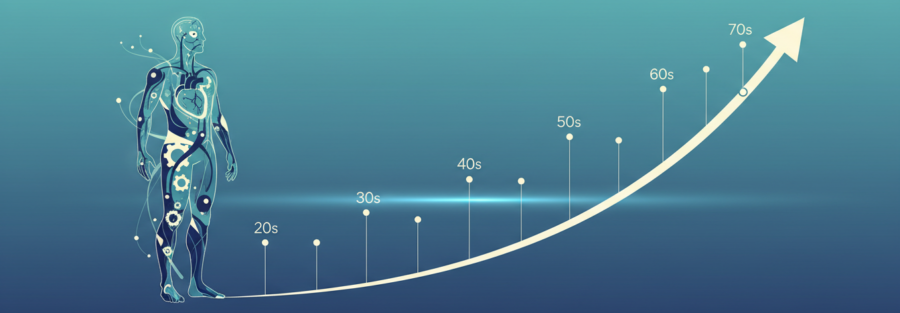
Erectile dysfunction can start at any adult age, but clinically meaningful ED becomes common after 40. Roughly 8% of men in their 20s, 11% in their 30s, 40% at 40, 50% at 50, 60% at 60, and 70% at 70 report some degree of erectile difficulty. When ED appears before 40, it is usually a signal of an underlying metabolic, hormonal, vascular, or psychological driver and deserves prompt urological evaluation.
The image most men carry of erectile dysfunction is a grey-haired man in his seventies. That image is outdated. In my Istanbul practice roughly one in three new ED patients is under 40, and a growing number are in their late twenties. If you have found this article by searching whether you are “too young” to have this problem, the honest answer is: probably not too young, and definitely not alone.
Age is a risk factor, not a diagnosis. Two men of the same age can have completely different erectile function based on their vascular health, hormones, sleep, medications, and stress. What follows is a decade-by-decade breakdown of what the data actually shows, what typically drives ED at each stage of life, and when the numbers should push you into a urology consultation.
Key takeaways
- ED prevalence rises roughly 10 percentage points per decade from age 40 onward.
- ED under 40 is almost always a warning sign of an underlying condition, not a normal variant.
- In the 40s, vascular disease becomes the dominant driver; in the 50s, testosterone decline joins the picture.
- Even men in their 70s can maintain excellent erections — biological age matters more than chronological age.
- Any man whose morning erections disappear, or who has ED for more than 3 months, should see a urologist regardless of age.
ED is not just an old man’s problem
The largest population study of erectile function, the Massachusetts Male Aging Study, was published in the early 1990s. It quantified the age curve most doctors still quote: 40% at 40, rising to about 70% at 70. What that study could not predict was how metabolic disease, sedentary lifestyles, chronic stress, and pornography-related conditioning would shift the curve leftward.
A non-drug option that some men trial first is low-intensity shockwave therapy for ED.
Newer datasets, including work from the Journal of Sexual Medicine after 2020, show that at least one in four men under 40 now report some form of ED. In a Turkish male-health survey of urban men aged 25–34, roughly 15% reported difficulty maintaining erection at least occasionally. The condition is younger than the textbooks suggest.
Prevalence table by decade (20s to 70s)
| Age band | Any degree of ED | Moderate to severe ED | Most common driver |
|---|---|---|---|
| 20–29 | ~8% | ~1% | Psychological, porn conditioning, drug use |
| 30–39 | ~11% | ~2% | Anxiety, early metabolic changes, medications |
| 40–49 | ~40% | ~5% | Vascular disease, low testosterone, stress |
| 50–59 | ~50% | ~10% | Hypertension, diabetes, testosterone decline |
| 60–69 | ~60% | ~18% | Cardiovascular disease, medications, comorbidities |
| 70+ | ~70% | ~30% | Advanced vascular disease, post-prostate surgery |
Note that “any degree of ED” is a broad category. Occasional difficulty is not the same as consistent inability. What matters clinically is whether the problem is stable, worsening, or reversing over three months.
Regenerative medicine adds a further tier: stem cell therapy for erectile dysfunction.
ED in your 20s — psychological vs organic
In a healthy 25-year-old, organic ED is uncommon. When it does happen the causes cluster into a small list:
The newer, cell-free regenerative sibling of stem cell work is exosome therapy for erectile dysfunction.
- Performance anxiety — the most common driver, often triggered by one failed episode
- Pornography conditioning — high-intensity, novelty-based stimulation making partnered sex feel muted
- Recreational drugs — cocaine, MDMA, anabolic steroids, cannabis
- SSRI antidepressants — sertraline and paroxetine particularly
- Endocrine issues — congenital hypogonadism, hyperprolactinaemia, thyroid disease
- Early metabolic syndrome — increasingly seen in obese 20-somethings
The tell-tale signs of psychogenic ED are preserved morning erections, full erections during masturbation, and situational failure that disappears with a new partner or a change of setting. If any of those features are missing, an organic workup is warranted.
ED in your 30s — early metabolic warning
The 30s are the decade when hidden metabolic problems start to show. A 34-year-old with a growing belly, high normal blood pressure, and mild insulin resistance may look healthy on paper but already has early endothelial dysfunction. Because the penile arteries are among the smallest in the body, they are the first to signal that something is wrong.
Anatomical length or girth is a separate procedure — details on our penis enlargement surgery page.
Any man in his 30s with new-onset ED should have at minimum: fasting glucose, HbA1c, lipid profile, morning testosterone, TSH, and blood pressure measurement. This simple panel identifies about 70% of the underlying drivers in this age group.
ED in your 40s — the vascular tipping point
The 40s are when the ED prevalence curve turns sharply upward. Two forces converge: vascular ageing (endothelial nitric-oxide production drops meaningfully) and the accumulation of chronic conditions (hypertension, dyslipidaemia, obesity, sleep apnoea).
If a diagnosis is missing, start with the 12 medical causes of erectile dysfunction.
This is also the decade when many men are first prescribed medications that affect erection quality — beta-blockers, thiazide diuretics, statins, SSRIs. A careful medication review is often the single most useful intervention. Substituting a beta-blocker with an ARB, for instance, can restore erection quality within weeks in the right patient.
Under 45 with new-onset erectile difficulty?
ED in your 50s — testosterone decline
Testosterone begins its slow decline in the 30s (about 1% per year) but the clinical effect usually becomes noticeable in the 50s. Symptoms cluster in a recognisable pattern: reduced morning erections, thinning gym results, quieter libido, more emotional flatness, deeper afternoon fatigue.
Not every man can safely take PDE5 tablets — see Viagra side effects and who should never take it.
A single morning total-testosterone measurement (drawn between 7 and 10 a.m., fasting), repeated on a second day, is the correct screening test. Free testosterone and SHBG give context. Levels below 300 ng/dL with symptoms usually justify treatment; between 300 and 400 the decision is nuanced and depends on symptoms and comorbidities.
Layered on top of hormones are decades of vascular ageing, which is why the 50s often need a combined approach: lifestyle overhaul, PDE5 inhibitor as needed, and, in selected patients, testosterone replacement or regenerative therapy such as exosomes.
ED in your 60s and beyond — comorbidities
By the 60s, roughly two out of three men have some erectile difficulty, and the driver is rarely a single cause. It is usually a stack: coronary artery disease, controlled or uncontrolled diabetes, three or four medications, occasionally a prior pelvic surgery, and a slow decline in general fitness.
Before medication, some men trial lifestyle changes — see natural remedies for erectile dysfunction.
The key clinical decision in this decade is whether the man is a candidate for PDE5 inhibitors (safe in most stable cardiovascular patients but contraindicated with nitrates), whether he needs injection therapy, or whether the honest answer is a penile prosthesis. Satisfaction with modern three-piece inflatable implants exceeds 90% in this age group.
When ED is a cardiovascular red flag
Because penile arteries are 1–2 mm in diameter and coronary arteries 3–4 mm, plaque narrows the penile vessels first. This is the physiological reason ED can precede a heart attack by three to five years.
For international pricing, read penile implant cost in Turkey.
In practice this means any man under 60 with new-onset ED — and any man of any age with concurrent chest discomfort, exertional breathlessness, or a family history of premature coronary disease — needs a cardiovascular assessment. Sending him home with a prescription for sildenafil and no cardiac evaluation is negligent medicine.
Age-appropriate treatment options
| Age | First-line | If needed | Consider |
|---|---|---|---|
| 20s | Psychological evaluation, lifestyle, drug review | Short course PDE5 inhibitor | Endocrine workup if libido low |
| 30s | Metabolic workup, weight, sleep | PDE5 inhibitor | Testosterone check |
| 40s | Cardiovascular screen, medication review | PDE5 inhibitor, ESWT if vascular | Regenerative therapy |
| 50s | Full workup, testosterone panel | PDE5 inhibitor + lifestyle | TRT if hypogonadal, exosomes |
| 60s+ | PDE5 inhibitor if cardiologically safe | Injection therapy | Penile prosthesis |
Doctor’s perspective — Op. Dr. Cem İpek
The younger the patient, the more work the diagnosis takes. A 65-year-old with hypertension and diabetes has an obvious cause. A 28-year-old with new ED forces us to look at anxiety, relationship dynamics, gym supplements, cannabis, undiagnosed thyroid disease, and hormonal imbalance. Skipping any of those is a missed diagnosis.
What surprises many international patients who fly to Istanbul for treatment is that we often do not need to add anything at all. Correcting a beta-blocker, treating sleep apnoea, or replacing a low testosterone level restores function without any ED medication. That is not always possible, but it is the goal.
Age is not destiny. I have 72-year-old patients with better erections than 42-year-olds because they have kept their arteries clean, their weight under control, and their sleep intact. Genetics play a role, but the daily choices of your 30s, 40s and 50s decide most of what you experience in your 60s and 70s.
When to see a urologist
Book a consultation if any of the following applies, regardless of your age:
A device-by-device breakdown is in our inflatable vs malleable penile implant guide.
- Erectile difficulty lasting more than three months
- Absent or weakening morning erections
- Any ED before age 40
- ED after starting a new medication
- Personal or family history of cardiovascular disease, diabetes, or hypertension
- Loss of libido alongside ED
- Painful erection or new curvature
Curious where you stand on the ED age curve?
Book a discreet international patient consultation with Dr. Cem İpek in Istanbul — full workup, no rushed prescription.
Frequently asked questions
Is ED at 25 normal?
Occasional difficulty is normal at any age. Persistent ED at 25 is not normal and warrants evaluation. Common drivers include performance anxiety, pornography conditioning, recreational drug use, antidepressants, anabolic steroids, and, less often, endocrine or metabolic conditions.
Can a 30-year-old have ED?
Yes. Roughly one in ten men in their 30s report some degree of erectile difficulty. New-onset ED in a 30-year-old is often the first signal of insulin resistance, low testosterone, sleep apnoea, or a medication effect. It should not be dismissed as stress until an organic workup has been done.
Do all men over 60 have ED?
No. Around 60% of men in their 60s report some erectile difficulty, meaning roughly 40% still have normal function. Men who maintain aerobic fitness, healthy weight, good sleep, and avoid smoking often retain excellent function well into their 70s.
At what age is ED most common?
Prevalence rises with each decade. It is most common in men over 70, where around 70% report some difficulty, but the sharpest increase occurs between the 30s and the 40s, where prevalence roughly quadruples due to the onset of vascular and metabolic disease.
Can ED reverse with age if you get healthier?
Yes, particularly in the earlier decades and particularly for lifestyle-driven ED. Quitting smoking, losing significant weight, treating sleep apnoea, and improving glycaemic control can meaningfully improve erection quality in 3 to 6 months. Established atherosclerosis is harder to reverse but can be stabilised.
Is it normal to lose morning erections with age?
Some reduction in frequency is normal, but complete disappearance of morning erections is not normal at any age. Absent morning erections usually point to an organic cause and should be evaluated.
- Feldman HA et al. Impotence and its medical and psychosocial correlates. Massachusetts Male Aging Study. J Urol. PMID: 8254833.
- European Association of Urology (EAU) Guidelines on Sexual and Reproductive Health, 2024 edition.
- American Urological Association (AUA) Guideline: Erectile Dysfunction, 2023.
- Nehra A et al. Diagnosis and treatment of erectile dysfunction for reduction of cardiovascular risk. J Urol. PMID: 23583624.
- Capogrosso P et al. One patient out of four with newly diagnosed ED is a young man — worrisome picture from the everyday clinical practice. J Sex Med. PMID: 23347307.



 DE
DE  EN
EN  TR
TR